Path of Exile 3.29: my Curse of the Allflame league
This blog is mostly clusters and YAML, but nobody survives on that alone. I've been playing Path of Exile since 2016 and I still start every league on launch day, which at this point sits somewhere between a hobby and a recurring calendar event.
Every league I start the same way: Explosive Arrow Ballista. It's cheap, it clears white maps with a four-link, and it gets me to red maps without buying anything. I've done this enough times that it's muscle memory now, which is the whole point. The first two days aren't where I want to be making decisions.
The same character went through three builds over the league, and poe.ninja kept snapshots of each one:
| When | Build | poe.ninja | PoB |
|---|---|---|---|
| Start to week 1 | Explosive Arrow Ballista | week 1 | pobb.in |
| Weeks 2 to 3 | Forbidden Rite of Soul Sacrifice | week 3 | pobb.in |
| Week 4 onward | Fireball with Pact of Beidat | current | pobb.in |
Forbidden Rite carried me through most of the atlas, but the Fireball Elementalist is where the league actually landed, and Pact of Beidat is the reason.
It's one of the new Exceptional skill gems from 3.29. The patch notes describe it as:
Cast a pact, Empowering spells that either fire projectiles, apply an effect to an area around a targeted location or fire chaining beams, causing them deal more damage and have enhanced coverage. However, using this skill also burdens you with an Affliction.
Fireball ticks two of those boxes at once, so it eats the whole buff. The end result was 5.3 metres of explosion area at around 140M DPS, with full real block underneath it. Screen-wide clear I never had to aim, and enough block that mapping stopped asking anything of me.
The Affliction is a real cost and you carry it for as long as the pact is up. Paying a permanent downside for that much damage is exactly the trade I like taking, and this is the first build in a while where I stopped optimizing because I ran out of things to fix instead of running out of currency.
The other half of the damage is Enmity's Embrace, a Vermillion Ring that turns your overcapped fire resistance into fire penetration, up to 200%. Every point of fire res past the cap stops being dead defensive stat and becomes damage. Nothing else in the game converts a stat that hard.
It charges for it. The ring cuts your fire resistance by a huge percentage and you take fire damage every time you use a skill, so the entire build reshapes itself around stacking res far past 75% just to get back to where you started, and then further.
That reduced fire resistance roll is the whole item. The lower it is, the less of your stacked resistance gets eaten before the overcap starts counting. Mine rolled 51%, the good end of the range, and rings at that roll were going for more than a mirror. It's the single most expensive thing I've ever put on a character, and the damage difference justified it.
The nice part is that the ring's drawback is what keeps the pact running. Pact of Beidat is a spell you cast, and nobody wants to babysit a buff every few seconds, so it goes into Cast on Ward Break Support. Ward comes from Svalinn, which is also where the block comes from, since its chance to block is lucky. And the thing that keeps breaking my ward is Enmity's Embrace hitting me with fire damage every time I use a skill.
   cast Fireball
        │
        ▼
   Enmity's Embrace ──> fire damage to self on skill use
        │
        ▼
   Svalinn's ward breaks
        │
        ▼
   Cast on Ward Break ──> re-casts Pact of Beidat
        │
        ▼
   pact is up, next Fireball is empowered ──┐
        ▲                                   │
        └───────── ward recharges ◄─────────┘
Three items whose downsides cancel out into a loop that runs itself. The pact is never not active, and I never press the button for it. Builds where the drawback is the engine are my favourite kind, and this is the cleanest one I've assembled.
The league mechanic
You find Lost Charts guarded by monsters in your maps, take them to Valerie's ship, and sail down to the sea floor. My friends and I just called it "o fundo do mar" the entire league and never once used the real name.
Charts on their own are small exploration runs. The interesting part is the Voyage: you place nine completed charts into a 3x3 grid and run them as one big zone, with every modifier stacking.
            Voyage grid (9 charts)
   ┌───────────┬───────────┬───────────┐
   │  corner   │   edge    │  corner   │
   │  2 adjac. │  3 adjac. │  2 adjac. │
   ├───────────┼───────────┼───────────┤
   │   edge    │  CENTER   │   edge    │
   │  3 adjac. │  4 adjac. │  3 adjac. │
   ├───────────┼───────────┼───────────┤
   │  corner   │   edge    │  corner   │
   │  2 adjac. │  3 adjac. │  2 adjac. │
   └───────────┴───────────┴───────────┘
     ▲                          ▲
     └── edge bonuses land here ┘
The grid is the whole game. A chart with an "adjacent" modifier hits two slots from a corner and four from the center, so your strongest adjacency chart goes in the middle and the quantity charts go around it, where the loot actually spawns. The sea creatures on the borders give bonuses to the tiles they touch, which is why the corners end up better than they look.
Once I understood that, placement stopped being "drop nine charts in" and became the part of the league I actually enjoyed. I like mechanics that reward planning between maps instead of during them.
Down there you're also harvesting Luminous Coral for Dead Man's Sulphur, which is the fuel for the league's crafting bench. That turned out to matter more to my league than the loot did.
The ring I should have chased on day one
Voyages can include Kishara's Rest, where you fight Velka, the Tide Witch. She drops the Pearl of Tsoatha, a Prismatic Ring that became the meta item of the league.
It rolls elemental resistances plus one or two support gem effects at level 20, applied to skills socketed in your helmet, gloves, or boots. A four-link helmet turns into something much closer to a six or eight-link, depending on the roll. The supports are random, so most of them are junk for your build and the one you want costs whatever the market says it costs.
I figured this out late. By the time I went shopping, the good rolls had already been priced by people who did the math in week one, and I paid a lot for mine. The lesson isn't new but I keep relearning it: read the new uniques before the economy does.
Drops
Loot-wise this was a strange league. Almost no divine drops, but the rare stuff showed up anyway.
- The Apothecary. A Mageblood card, out of nowhere.
- House of Mirrors. The Mirror of Kalandra set. I still don't quite believe it.
- Voices, 3 small passives. The expensive roll, which almost never happens to me.
The one I'm most pleased with was Hinekora's Lock. I had a partial stack and used the Harvest card gamble, where you sacrifice up to half a stack and get back somewhere between zero and double. It's negative expected value and everyone knows it. I went full stack anyway.
The craft that paid for the league
The real income wasn't drops, it was crafting energy shield chests and selling them. Once the recipe worked, it worked every time, which is rarer than a good drop.
Twilight Regalia, fractured T1 energy shield (flat or increased)
  │
  ├─ spam Deafening Essence of Loathing ──> until T1 Intelligence lands
  │
  ├─ bench craft: 6% increased Attributes
  │
  ├─ Eldritch Chaos Orb / Orb of Annulment ──> until T1 Energy Shield
  │
  └─ fix implicits, then Tailoring Orb for increased explicit magnitudes
The fracture is what makes it viable. An Eldritch Chaos Orb doesn't reroll the whole item: it reforges only the prefixes or only the suffixes, depending on which Eldritch implicit is dominant. With Searing Exarch dominant it hits the prefixes, which is where the energy shield mod lives. The T1 Intelligence suffix and the bench craft stay put, and the fractured mod is never touched at all.
The essence choice matters more than it looks. Deafening Essence of Loathing gives mana reservation efficiency on body armour, which is a mod buyers want on its own, so even the failed attempts sell for something instead of going to the vendor. That's what turned this from a lottery into a routine: the floor was high enough that I could keep rolling.
Buying the bases was the boring half. Twilight Regalia with a T1 fractured energy shield mod, checked every day, bought whatever showed up under my threshold.
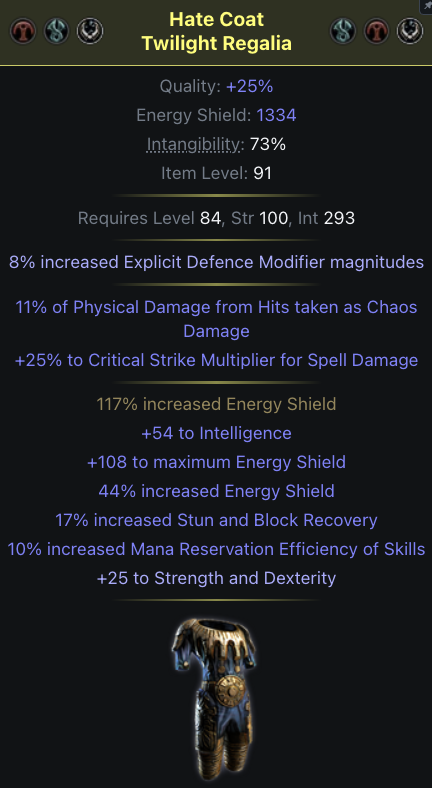
This one I kept for myself. The two increased energy shield rolls plus the flat one land at 1334 total, the 10% mana reservation efficiency is the essence mod that was there from the start, and the 8% increased explicit defence modifier magnitudes at the top is the Tailoring Orb enchant.
The bench craft is the one deviation from the recipe. Instead of 6% increased attributes I went with +25 to Strength and Dexterity, because my Fireball build was starving for attributes and the chest already demands 100 Str and 293 Int on its own. Flat attributes solved a problem the percentage never would have.
Vesper's bench changes the odds
The part that made this league's crafting different is that you can run these steps at Vesper's Allflame bench instead of clicking the currency onto the item. You feed it the item plus the currency, pay Dead Man's Sulphur, and it shows you up to four ghostly copies of the outcome. You pick one and the other three disappear.
   item + 1 Exalted Orb + Dead Man's Sulphur
                    │
                    ▼
        ┌───────┬───────┬───────┬───────┐
        │ copy1 │ copy2 │ copy3 │ copy4 │   ghostly copies
        └───────┴───────┴───────┴───────┘
                    │
                    ▼
              pick one, keep it     (+X% Intangibility)
One Exalted Orb giving you four rolls to choose from is a completely different game from one Exalted Orb giving you one roll. On an annul step it's the difference between removing the mod you wanted gone and bricking the item.
The catch is Intangibility. Every successful craft raises that percentage on the item, and the higher it goes, the more likely the bench gives you fewer copies, down to a single one. That's the whole tension: the item gets better and the bench gets worse at the same time, so you have to decide when to stop upgrading and start selling. The chest above ended at 73% Intangibility, which is roughly the point where the bench stops giving you a choice at all. I stopped early more often than I wanted to, and I think that was the correct call.
Scrying Orbs
3.29 also brought the Scrying Orb, which fixed something that had annoyed me for years.
Scrying means overwriting one map's divination card pool with another map's. Before this, doing it meant running into the Nameless Seer, an NPC that spawns randomly from monster kills in high tier maps. You couldn't plan around him. You just ran maps and hoped, and when he finally showed up you'd better have known in advance which map you wanted.
Now it's an item. A Scrying Orb remembers the map it dropped in, you apply it to a map on your atlas, and that map's card pool is replaced. Since it's a currency item, it's tradable, so you can just buy the one you need.
before:  run T16 maps ──> hope the Nameless Seer spawns ──> scry, if he did
after:   buy the Scrying Orb you want ──> apply to a map ──> done
I always scry into Dunes, Jungle Valley, or City Square. Open layouts, fast to clear, so the farming loop doesn't fight me while I'm doing it.
Turning an RNG encounter into something you can buy is the kind of change that doesn't show up in a league trailer and quietly makes the game better to play.